

Event merchant closeout: a reporting worksheet for Saudi organizers
Agree the reporting period, merchant and selling point, sale and payment records, reviewer and exception owner before your event closes.
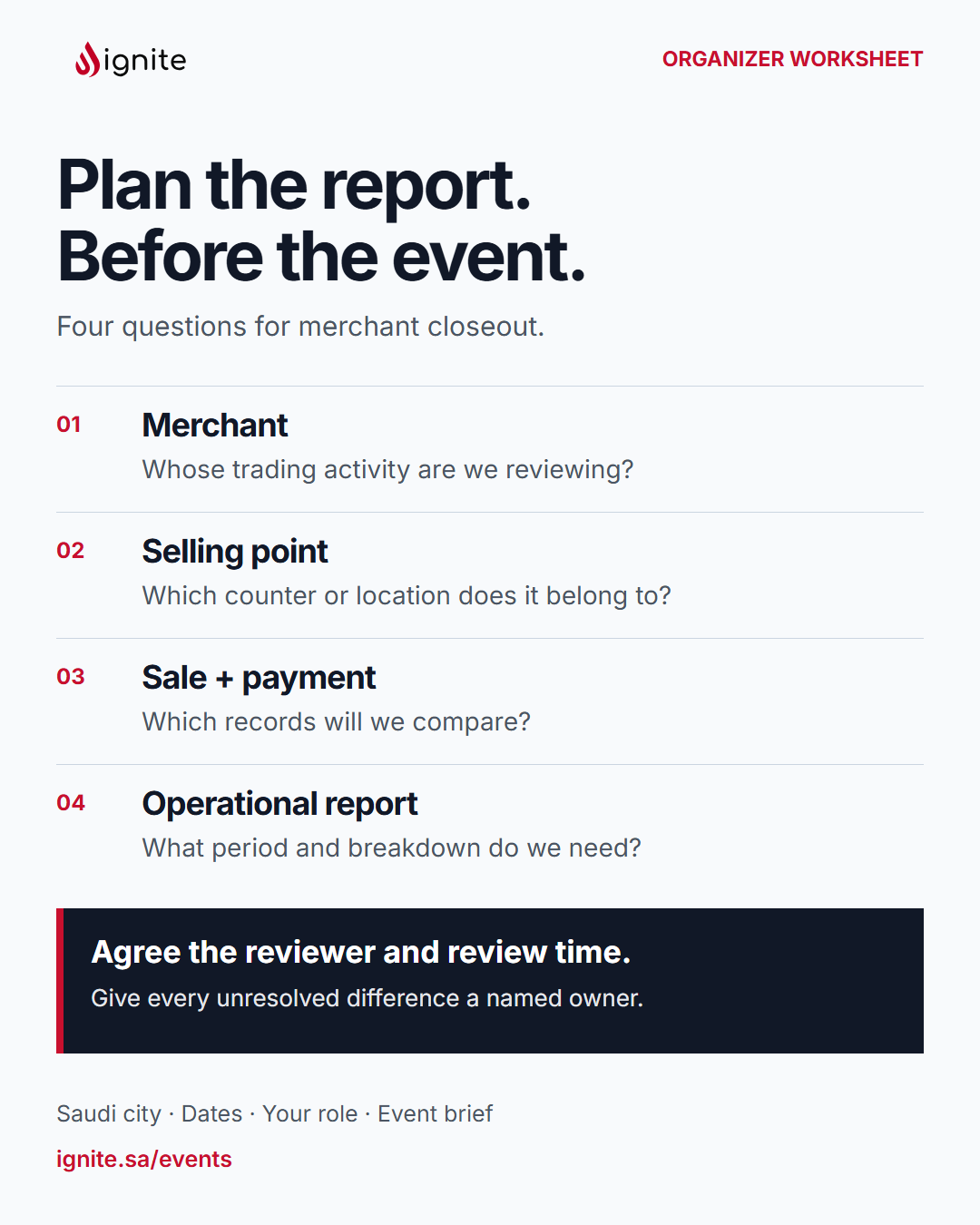
Imagine the event has closed, but a merchant’s sales total and payment total do not match. Before asking someone to investigate, establish whether both figures cover the same period, business and selling points. A clear closeout brief gives the reviewer a defined question and gives unresolved differences an owner.
Agree that brief before trading begins. It should tell the organizer, merchant and operations team what they will review, when they will review it and what happens next. The worksheet below helps you make those decisions without turning the closing conversation into a search through messages.
Define the period before comparing totals
Write a start and end date, time and time zone. Decide whether the review covers a trading day, a particular event session or the full event. For an event that trades past midnight, make clear where one reporting period ends and the next begins.
Ask whether the records being compared use the same time boundary. Also agree how later corrections will be brought into the review. Keep the original period visible when a revised figure is discussed, so everyone knows which activity the update concerns.
Identify the merchant and selling point
Use the agreed merchant name and name each included selling point. A business operating across several event zones may need a review by location as well as a combined view. Make the requested breakdown explicit.
Check that the person preparing the records and the person reviewing them mean the same business and locations. If a counter changed hands during the event, note who is responsible for explaining the activity in question. Clear ownership is more useful than a label such as “all counters” that different teams interpret differently.
Agree which records answer which question
Sales records help explain what was sold. Payment records help explain the associated payment activity. Customer documents may help clarify an individual transaction. Choose the records needed for your question, and name who will provide them.
Before comparing totals, agree how recorded refunds, cancellations or corrections should be treated. Ask which records include those changes and whether the figures being compared are prepared on the same basis. A difference is a reason to investigate its cause; it does not, by itself, establish a missing payment.
Ignite Commerce brings catalog, orders, payments and invoicing into one commerce platform, with location operations and reporting. For closeout planning, describe the business question and the breakdown you need: for example, a merchant’s activity at each selling point during the agreed period.
Set the review time and the next action
Name the person who prepares the records, the person who reviews them and the merchant contact who can explain a sale. Agree a time for the first review and a time to revisit unresolved questions.
For each difference, capture the question, the records already checked, the next action and its owner. State what information is still needed. A named contact and a dated next step help organizers and merchants resolve differences without repeating the same checks.
Blank planning template: copy and complete
Use one worksheet for each agreed review scope. Fill the blanks with your team; keep customer details in the appropriate business records.
Event
Event name, Saudi city and venue: ….
Your role and responsibility
Organizer, production team or merchant: … Responsible for: ….
Reporting period
Start date/time: … End date/time: … Time zone: ….
Merchant and selling points
Merchant: … Included locations: … Required breakdown: ….
Records to compare
Sales records: … Payment records: … Other relevant documents: ….
Comparison basis
Treatment of recorded refunds, cancellations and corrections: ….
Review responsibility
Prepared by: … Reviewed by: … Merchant contact: ….
Review timing
First review: … Follow-up for open questions: ….
Open difference
Question: … Records checked: … Next action: … Owner: … Review date: ….
Conclusion
Explanation checked by: … Conclusion and date: ….
Keep the wider event operation connected
Merchant closeout is one part of the event brief alongside registration, access and on-site support. The merchant POS and payments guide covers preparation and trading; the organizer requirements guide brings the wider responsibilities together.
Plan your event with Ignite. Share your role, Saudi city, event dates, merchant and selling-point scope, and the reporting questions your team needs to answer. Discuss your event brief to connect those needs with the wider technology and managed-support plan.