

Event ticketing vs registration: what your Saudi event needs
Choose the right admission journey for your Saudi event: free registration, invitations, paid tickets or mixed categories, with a practical comparison.
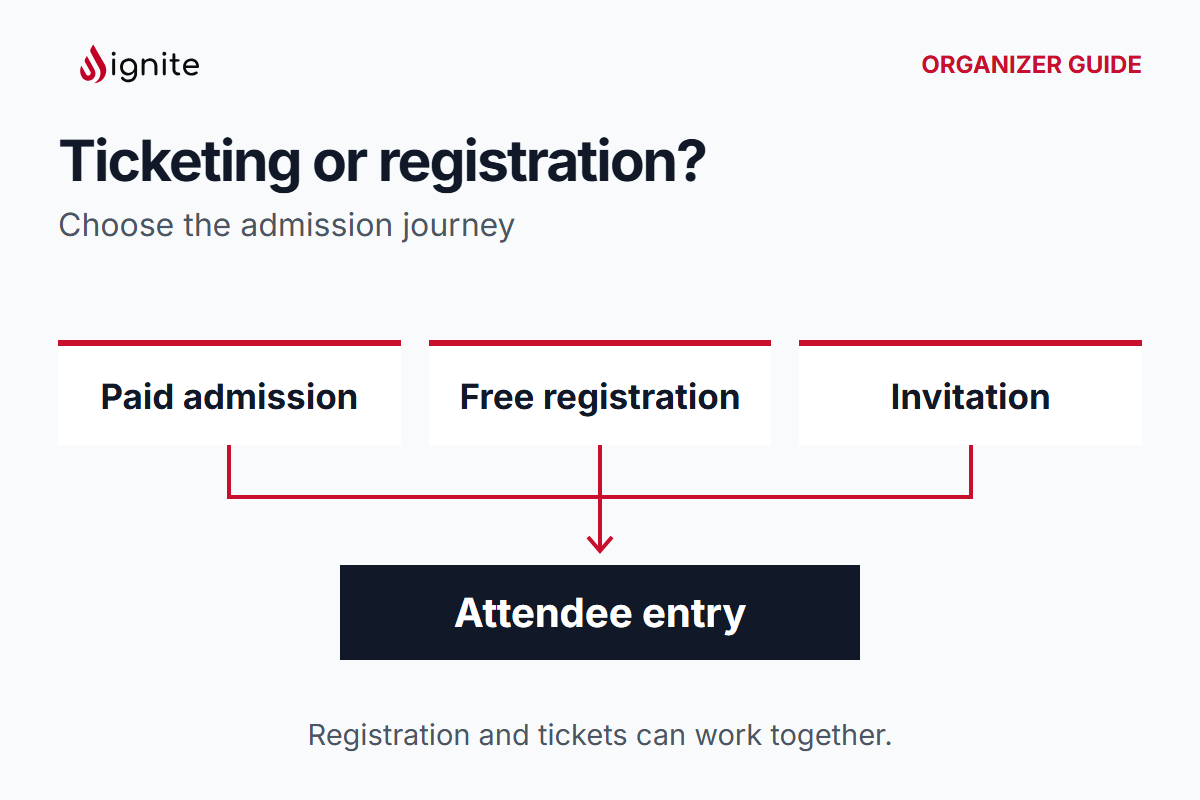
Start with one question: what must a person do before you confirm their place? They might submit their details, accept an invitation, receive organizer approval or pay for admission. That decision shapes the attendee journey, the information your team needs and the confirmation you send.
Registration and ticketing often work together. Registration collects the attendee’s information and records their participation. A ticket or pass represents admission to a defined experience. Tickets can be free; collecting a payment is only one possible step. Choosing the right model gives attendees a clearer next action and gives organizers a more useful attendee list.
Choose the admission model first
Write the rule for each audience before choosing the form or check-in screen. A public visitor, exhibitor, speaker and invited guest may attend the same event through different journeys. Decide what each category includes and who can confirm it.
Scroll the table horizontally to review each decision and its evidence.
| Model | Suitable audience | Step before confirmation | What confirmation should explain | Decision owner |
|---|---|---|---|---|
| Free open registration | Visitors who can sign up directly | Required details submitted | Date, location and included admission | Registration lead |
| Invitation or approval | Selected guests or applicants | Invitation accepted or application approved | Confirmed category and included areas | Guest or audience lead |
| Paid admission | Attendees purchasing entry | Required details and payment completed | Ticket category, date and what is included | Ticketing and finance leads |
| Mixed categories | An event combining these audiences | The rule for the selected category | The attendee’s specific admission entitlement | Event lead with category owners |
These are planning models. A free event can still issue tickets, and a paid conference can still need detailed registration. Describe the journey in terms attendees understand: apply, register, accept your invitation or buy a ticket.
Ask for information your team will use
For every field, name its purpose and owner. A name may appear on a badge; an email address may receive confirmation; a company and role may help an organizer review a professional audience. A workshop choice may determine which session the attendee expects to join.
Separate information needed to confirm attendance from information that can be collected later. Keep Arabic and English questions equivalent, especially category names and what each option includes. For international teams, agree one set of category definitions so the registration brief, confirmation and on-site team use the same terms.
Three illustrative organizer examples
A free industry exhibition
An organizer wants professionals to register before visiting. Free open registration may suit the visitor audience, while exhibitor staff follow a separate category. The important decision is whether a completed form confirms admission or starts an application for review. State that distinction clearly on the registration page and in the response.
A conference with paid workshops
An organizer plans general conference admission and separately selected workshops. Define whether each workshop is included, separately purchased or reserved independently. Specify what the attendee receives after each step and how the registration team will recognize the final selection. Avoid a single vague label such as “full access” when the programme contains different entitlements.
An invitation-only launch
A guest team invites a selected audience and asks for an RSVP. Decide whether a guest can bring someone, whether that person needs their own details recorded and who can change the guest list. The useful outcome is a clear confirmed list that the arrival team can interpret. A payment step adds no value when admission is by invitation alone.
Carry the decision through to arrival
The confirmation should answer: am I confirmed, for which date and category, and what happens next? At arrival, staff need to connect the person’s record with the admission granted. Registration, confirmation and check-in should use consistent categories.
The Saudi Law Conference project connected registration, ticketing and payment with QR check-in, workshop attendance and event-area access. It illustrates how the digital journey and on-site operation can form one brief.
Use our QR check-in guide to plan gate decisions and access exceptions. For products sold by merchants inside the venue, use the separate event POS and payments guide.
Give your supplier a clear admission brief
Share the event date and venue, audience categories, expected attendance, confirmation rule for each category, required attendee information and included sessions or areas. Name the owners of guest approvals, payment questions and arrival decisions. Include a sample confirmation so everyone can review the experience the attendee will receive.
Our organizer requirements guide covers the wider supplier brief. Explore Ignite for Events, then discuss your registration and ticketing needs with the team. Start with your audience and admission rules to shape the right event journey.